Proprietary Blends Explained: What That One Label Line Leaves Out
A proprietary blend lists a group of ingredients under one combined weight, without disclosing each one's individual amount, per OPSS guidance. Neuro Pulse Pro's 179.5 mg blend holds 11 ingredients, including fo-ti, which LiverTox rates a well-established cause of liver injury, and horsetail, which contains thiaminase. No individual amount is published, so ask a seller for lab-verified amounts and a current Certificate of Analysis before buying.
Proprietary blends explained: what that one label line does not tell you
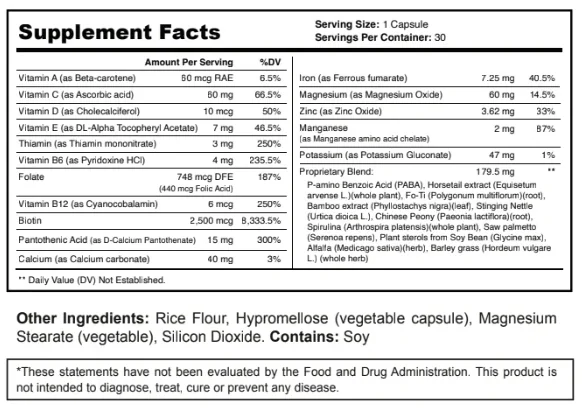
Look past the vitamins and minerals on the Neuro Pulse Pro label and you hit one more line: Proprietary Blend, 179.5 mg, followed by 11 ingredient names and a double asterisk. That line works differently from every other row on the panel.
This guide explains what a proprietary blend is and why the U.S. Department of Defense's supplement-safety program flags it as a transparency problem, walks through what is actually inside Neuro Pulse Pro's 179.5 mg blend, covers the one ingredient in it with a real liver-injury warning, and lists the questions worth asking before you buy any product built this way.
What is a proprietary blend?
A proprietary blend is a group of ingredients a manufacturer lists together on the Supplement Facts panel under one combined weight, instead of listing each ingredient's individual amount (Operation et al., 2023).
Operation Supplement Safety (OPSS), a U.S. Department of Defense program, explains that a proprietary blend lets a manufacturer disclose only the total combined weight of a group of ingredients, without showing how much of any single ingredient it contains (Operation et al., 2023).
That is legal. It is also, in OPSS's own words, a real gap: the lack of transparency makes it impossible for a consumer to know their actual exposure to any one ingredient inside the blend (Operation et al., 2023). You can see the total weight and the ingredient list, in order, but not how the 179.5 mg is actually split among the 11 names.
Why do the individual amounts actually matter?
Amounts matter because almost every ingredient's effect, and its safety, depends on dose. A tiny amount of a well-studied herb can do nothing at all, while a larger amount of the same herb might carry a real risk, or a real benefit. Without the individual number, you cannot line an ingredient up against the dose used in research.
OPSS specifically recommends looking for third-party testing or certification on products with proprietary blends, since laboratory testing is the only way to independently verify what a blend actually contains (Operation et al., 2023). Neuro Pulse Pro's label does not list a third-party certification mark.
This is not unique to Neuro Pulse Pro. Proprietary blends are common across the supplement industry, and the transparency problem is the same wherever the format is used.
What is actually inside Neuro Pulse Pro's 179.5 mg blend?
Neuro Pulse Pro's Proprietary Blend totals 179.5 mg per capsule and lists 11 ingredients in this order on the label. The panel marks it with a double asterisk, meaning "Daily Value (DV) Not Established," since there is no official Daily Value for a blend like this.
| Ingredient (as printed on the label) | Individual amount |
|---|---|
| P-amino Benzoic Acid (PABA) | Not published |
| Horsetail extract (Equisetum arvense L.) (whole plant) | Not published |
| Fo-Ti (Polygonum multiflorum) (root) | Not published |
| Bamboo extract (Phyllostachys nigra) (leaf) | Not published |
| Stinging Nettle (Urtica dioica L.) | Not published |
| Chinese Peony (Paeonia lactiflora) (root) | Not published |
| Spirulina (Arthrospira platensis) (whole plant) | Not published |
| Saw palmetto (Serenoa repens) | Not published |
| Plant sterols from Soy Bean (Glycine max) | Not published |
| Alfalfa (Medicago sativa) (herb) | Not published |
| Barley grass (Hordeum vulgare L.) (whole herb) | Not published |
Split evenly, 179.5 mg across 11 ingredients would average about 16 mg each, but blends are almost never split evenly; the label's ingredient order is often, though not always, roughly weight-descending. There is no way to confirm the real split from the label alone.
Two names on this list carry documented safety notes worth knowing: fo-ti, covered next, and horsetail, which contains thiaminase, an enzyme that can break down thiamine (vitamin B1) with long-term use (RxList et al., 2023). Saw palmetto, also in the blend, may add to the effect of blood thinners (Memorial et al., 2024), and spirulina has a comparatively reassuring safety record (LiverTox (National Institute of Diabetes and Digestive and Kidney Diseases), 2019).
Why does the fo-ti in this blend matter?
LiverTox, run by a National Institutes of Health institute, rates fo-ti (Polygonum multiflorum, also called He Shou Wu) a well-established cause of clinically apparent liver injury, with a likelihood score of A, its highest rating for evidence linking a substance to liver damage (LiverTox (National Institute of Diabetes and Digestive and Kidney Diseases), 2020).
LiverTox describes the injury as typically resembling acute hepatitis: fatigue, nausea, right-upper-quadrant pain, dark urine and jaundice, with onset ranging from days to as long as six months after starting use. Up to 10% of clinically apparent cases have been fatal or required an urgent liver transplant, and injury has recurred faster and more severely on re-exposure (LiverTox (National Institute of Diabetes and Digestive and Kidney Diseases), 2020).
Because Neuro Pulse Pro does not publish how much fo-ti is in its 179.5 mg blend, there is no way to know whether the amount here is small or substantial. Anyone using this product should watch for fatigue, nausea, dark urine or yellowing of the skin or eyes, and stop use and see a doctor right away if any of those appear; people with a history of liver disease should avoid fo-ti-containing products altogether.
What should you ask before buying a product with a proprietary blend?
A proprietary blend is not automatically dangerous, but it does put more of the burden on you to ask questions before buying. Worth asking any seller of a blended product:
- Can you tell me the individual amount of each ingredient in the blend, even if it is not on the label?
- Is there a current, publicly available third-party lab test (a Certificate of Analysis) for this specific lot?
- Does the amount of any single ingredient come close to, or exceed, the dose used in published research?
- Are any of the blend's ingredients ones I should avoid given my own medications or health conditions?
- Is the blend's total weight large enough to plausibly deliver a meaningful amount of every ingredient listed?
Neuro Pulse Pro publishes a lot number (NEU-26/NE-1900) and a CoA reference (NEU-1900-26-NE), but these are draft references, not independently verified lab proof, and neither breaks out the blend's individual amounts. If a seller cannot or will not answer the first question above, that itself is useful information.
Should the proprietary blend change how you think about this product?
A proprietary blend trades transparency for a shorter label. That trade is legal, and OPSS's own guidance is not that blends are unsafe, but that consumers cannot know their real exposure to any one ingredient inside one (Operation et al., 2023).
Neuro Pulse Pro's 179.5 mg blend packs 11 ingredients, including one, fo-ti, with a well-established liver-injury warning (LiverTox (National Institute of Diabetes and Digestive and Kidney Diseases), 2020), into a single unlabeled total. Nothing here tells you how much fo-ti, horsetail, saw palmetto or any other single ingredient you would actually be taking.
If a liver-injury risk, or any ingredient in this blend, is a concern given your own health or medications, that is a conversation for a pharmacist or doctor, not a label. For the rest of the formula, see B vitamins and nerve health and biotin and lab tests. The full ingredients page, Supplement Facts breakdown and side effects page cover every other line on the label.
Questions readers ask
What is a proprietary blend on a supplement label?
A group of ingredients listed under one combined weight, without disclosing how much of each individual ingredient it contains, per OPSS's definition (Operation et al., 2023).
Why does the individual amount of each ingredient matter?
Because an ingredient's effect and safety both depend on dose. Without the individual number, you cannot compare what you are taking to the dose used in any published research on that ingredient.
How much fo-ti is in Neuro Pulse Pro?
The label does not say. Fo-ti is one of 11 ingredients inside the 179.5 mg proprietary blend, and no individual amount is published for any of them.
Is fo-ti dangerous?
LiverTox rates fo-ti (Polygonum multiflorum) a well-established cause of clinically apparent liver injury, sometimes severe or fatal. Watch for fatigue, nausea, dark urine or yellowing skin, and stop use and see a doctor if they occur (LiverTox (National Institute of Diabetes and Digestive and Kidney Diseases), 2020).
What else is in Neuro Pulse Pro's proprietary blend?
PABA, horsetail, fo-ti, bamboo extract, stinging nettle, Chinese peony, spirulina, saw palmetto, plant sterols from soy, alfalfa and barley grass, all sharing one 179.5 mg total.
Does horsetail in the blend carry any risk?
Clinical references note horsetail contains thiaminase, an enzyme that can break down thiamine (vitamin B1) with long-term use, and may deplete potassium (RxList et al., 2023).
What should I ask a seller about a proprietary blend?
Ask for the individual amount of each ingredient, a current third-party Certificate of Analysis, and whether any ingredient's amount could plausibly reach the dose used in research for it.
Is a proprietary blend automatically unsafe?
No. It is a labeling format, not a safety claim either way. The concern OPSS raises is transparency: you cannot know your real exposure to any single ingredient inside the blend (Operation et al., 2023).
Keep reading
B vitamins and nerve health
What thiamin, B6, B12 and folate do for nerves, who runs low, B6 toxicity, folic acid masking B12, the Cochrane review, ...
Read →Biotin and lab tests
Why high-dose biotin skews blood tests, the FDA troponin warning, thyroid test effects, and what to tell your clinician ...
Read →How much does Neuro Pulse Pro cost?
Pack sizes, days of supply and how to pick the right one.
Read →Order Neuro Pulse Pro from the authorized retailer
30 capsules per bottle, 1 a day. Packs of 2, 3 or 6 bottles run from $49 a bottle on the sales page, with a 180-day money-back guarantee. Order questions go through the contact page on the official sales site.