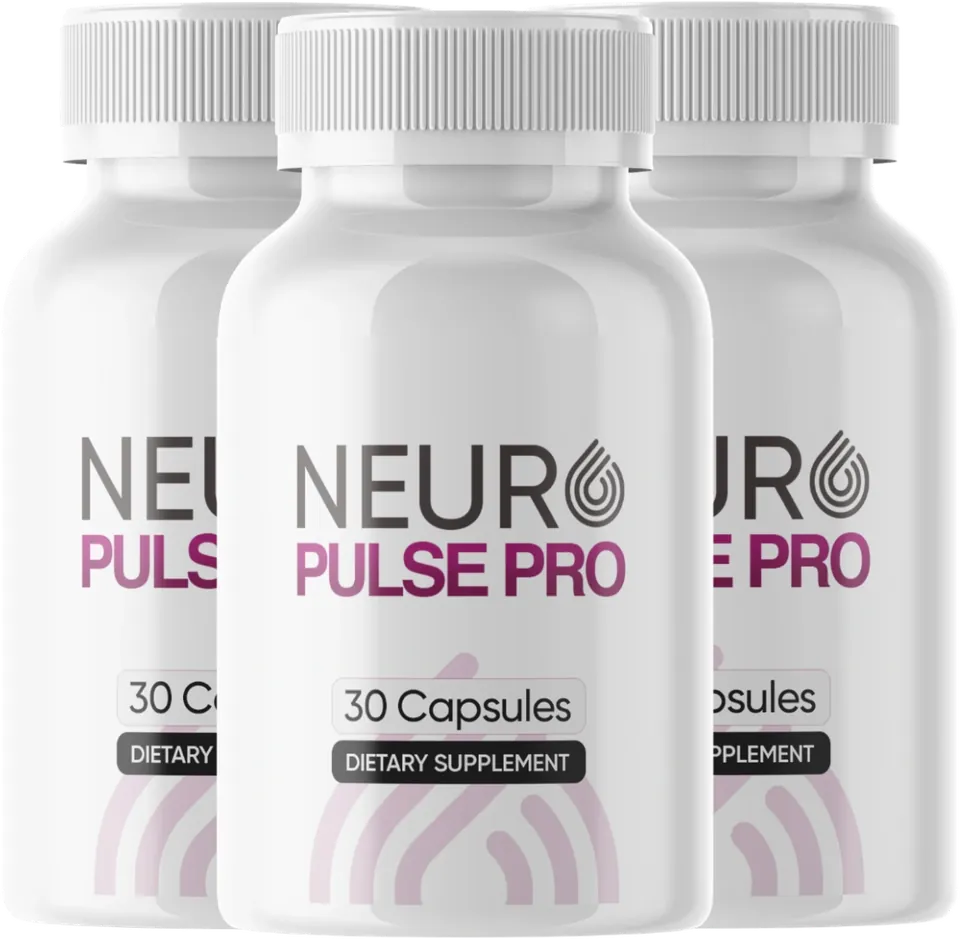
Neuro Pulse Pro Ingredients: The Full Label, Explained
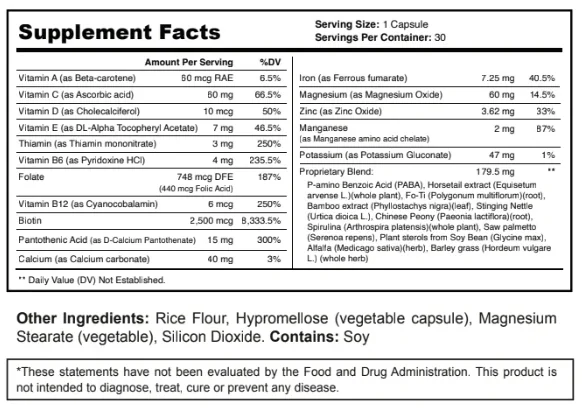
Neuro Pulse Pro's label lists 16 vitamins and minerals, led by biotin at 2,500 mcg (8,333.5% DV), plus a 179.5 mg proprietary blend of 11 ingredients such as fo-ti, horsetail and saw palmetto, with no single amount published. The mix reads like a hair, skin and nail formula. It has none of the nerve-specific ingredients, such as alpha-lipoic acid or benfotiamine, that dedicated nerve formulas use.
What are the 16 vitamins and minerals in Neuro Pulse Pro?
Sixteen nutrients, sixteen printed amounts, before the 11-ingredient blend below.
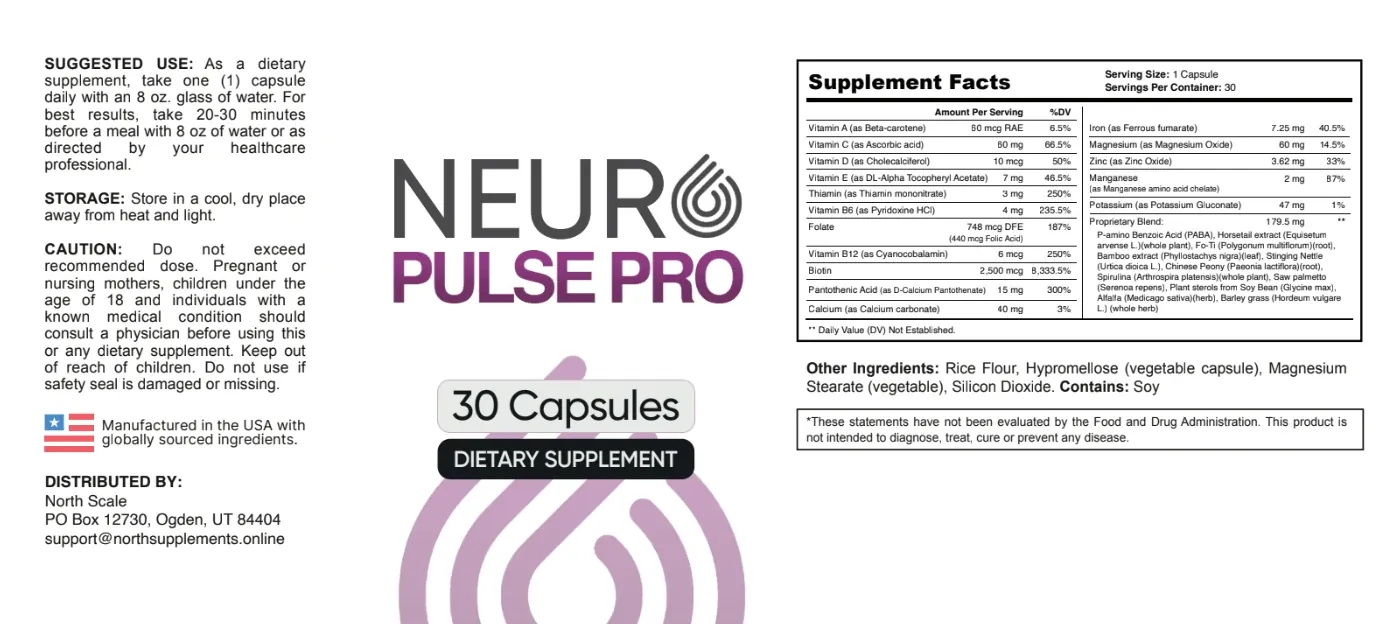
Every vitamin and mineral here gets its own printed amount. The 179.5 mg blend, below, does not.
| Vitamin or mineral | Amount per capsule | % Daily Value |
|---|---|---|
| Vitamin A (as Beta-carotene) | 60 mcg RAE | 6.5% |
| Vitamin C (as Ascorbic acid) | 60 mg | 66.5% |
| Vitamin D (as Cholecalciferol) | 10 mcg | 50% |
| Vitamin E (as DL-Alpha Tocopheryl Acetate) | 7 mg | 46.5% |
| Thiamin (as Thiamin mononitrate) | 3 mg | 250% |
| Vitamin B6 (as Pyridoxine HCl) | 4 mg | 235.5% |
| Folate | 748 mcg DFE (440 mcg Folic Acid) | 187% |
| Vitamin B12 (as Cyanocobalamin) | 6 mcg | 250% |
| Biotin | 2,500 mcg | 8,333.5% |
| Pantothenic Acid (as D-Calcium Pantothenate) | 15 mg | 300% |
| Calcium (as Calcium carbonate) | 40 mg | 3% |
| Iron (as Ferrous fumarate) | 7.25 mg | 40.5% |
| Magnesium (as Magnesium Oxide) | 60 mg | 14.5% |
| Zinc (as Zinc Oxide) | 3.62 mg | 33% |
| Manganese (as Manganese amino acid chelate) | 2 mg | 87% |
| Potassium (as Potassium Gluconate) | 47 mg | 1% |
Four B vitamins sit at 187-300% DV. Biotin, at 8,333.5% DV, is the biggest number on the panel. Full read: Neuro Pulse Pro Supplement Facts.
Explore the key Neuro Pulse Pro ingredients
Tap through. Each panel shows the research dose, the evidence level and a safety note.
Biotin
vitamin B7 · vitamin
The largest dose on the label by far, typical of hair, skin and nail formulas. This label's 2,500 mcg (8,333.5% DV) dose is roughly 83 times the 30 mcg/day AI.
- In one capsule
- 2,500 mcg (8,333.5% DV)
- Dose used in research
- NIH ODS Adequate Intake
- Safety note
- Biotin has no established Tolerable Upper Intake Level because it has not been shown to be directly toxic even at high doses, so this label's 2,500 mcg is not a known safety hazard by itself.
- Sources
- No human trials found
Vitamin B12
cyanocobalamin · vitamin
Needed for healthy nerves; low B12 can cause numbness and tingling. This label's 6 mcg (250% DV) dose is well above the 2.4 mcg/day RDA and B12 has a low toxicity potential.
- In one capsule
- 6 mcg (250% DV)
- Dose used in research
- RDA is 2.4 mcg/day for adults
- Safety note
- Vitamin B12 has a low potential for toxicity and no Tolerable Upper Intake Level has been set, so this label's 6 mcg dose is not a safety concern in itself.
- Sources
- No human trials found
Vitamin B6
pyridoxine HCl · vitamin
Needed for nerve signaling. Very high long-term doses can themselves harm nerves; 4 mg is far below that. This label's 4 mg (235.5% DV) dose is above the RDA but far below the 100 mg/day UL and well below the 1,000-6,000 mg/day range that NIH ODS links to sensory neuropathy after over a year of use.
- In one capsule
- 4 mg (235.5% DV)
- Dose used in research
- RDA is 1.3-1.7 mg/day for adults
- Safety note
- This label's 4 mg vitamin B6 dose is far below the 100 mg/day adult Tolerable Upper Intake Level and the multi-gram daily doses linked to nerve damage, so it is not expected to cause harm on its own.
- Sources
- No human trials found
Thiamin (B1)
thiamin mononitrate · vitamin
A B vitamin the nervous system relies on for energy. This label's 3 mg (250% DV) dose is a modest multiple of the RDA and well within the range NIH ODS reports as free of adverse effects.
- In one capsule
- 3 mg (250% DV)
- Dose used in research
- RDA is approximately 1.1-1.2 mg/day for adults
- Safety note
- Thiamin has no established Tolerable Upper Intake Level and this label's 3 mg dose is well within the range NIH ODS reports as free of adverse effects.
- Sources
- No human trials found
Folate
folic acid · vitamin
Works with B12. 440 mcg of folic acid is under the 1,000 mcg adult upper limit. This label's 748 mcg DFE (440 mcg folic acid, 187% DV) dose is under the 1,000 mcg/day UL for folic acid.
- In one capsule
- 748 mcg DFE (440 mcg folic acid)
- Dose used in research
- RDA is 400 mcg DFE/day for adults
- Safety note
- This label's 748 mcg DFE (440 mcg folic acid) dose is under the 1,000 mcg/day adult Tolerable Upper Intake Level for folic acid, so it is not expected to cause harm on its own, but people taking other folic-acid-fortified foods or supplements should track total intake.
- Sources
- No human trials found
Iron
ferrous fumarate · mineral
Most adult men and post-menopausal women do not need extra iron; ask a clinician first. This label's 7.25 mg (40.5% DV) ferrous fumarate dose sits below the RDA range and well under the 45 mg/day UL, which is a reasonable, non-excessive amount.
- In one capsule
- 7.25 mg (40.5% DV)
- Dose used in research
- RDA is 8 mg/day
- Safety note
- This label's 7.25 mg ferrous fumarate dose is below the adult RDA range and well under the 45 mg/day Tolerable Upper Intake Level, so it is not expected to cause iron overload in a typical healthy adult.
- Sources
- No human trials found
Fo-Ti
Polygonum multiflorum · root
A traditional Chinese root linked to rare but serious liver injury. LiverTox rates Polygonum multiflorum (fo-ti / He Shou Wu) a well-established (score A) cause of clinically apparent liver injury, sometimes severe or fatal.
- In one capsule
- Inside the 179.5 mg blend (amount not published)
- Dose used in research
- no established safe supplement dose
- Safety note
- LiverTox rates fo-ti (He Shou Wu / Polygonum multiflorum) a well-established cause of clinically apparent liver injury, which can resemble acute viral hepatitis, and up to 10% of clinically apparent cases have been fatal or required urgent liver transplant.
- Sources
- No human trials found
Horsetail
Equisetum arvense · whole plant
A silica-rich plant used in hair formulas; raw forms can break down thiamin. There is no evidence horsetail improves nerve comfort.
- In one capsule
- Inside the 179.5 mg blend (amount not published)
- Dose used in research
- no established efficacy dose
- Safety note
- LiverTox rates horsetail a probable but rare cause of liver injury, generally well tolerated with only minor gastrointestinal or allergic side effects reported.
- Sources
- No human trials found
PABA
para-aminobenzoic acid · compound
Once sold for gray hair; there is little human evidence for it as a supplement. PABA is best known as a sunscreen ingredient (applied topically), not an oral supplement with proven benefits; MedlinePlus reports it can be harmful in large amounts, causing gastrointestinal, allergic, and in severe cases liver symptoms.
- In one capsule
- Inside the 179.5 mg blend (amount not published)
- Dose used in research
- no established therapeutic dose
- Safety note
- PABA is not a recognized essential vitamin despite sometimes being marketed as 'vitamin Bx,' and MedlinePlus notes it can be harmful in large amounts, with overdose or allergic reactions causing gastrointestinal symptoms, rash, breathing difficulty, and in severe cases liver failure.
- Sources
- No human trials found
Saw Palmetto
Serenoa repens · berry
Mostly studied for prostate symptoms and hair loss, not nerves. The 2023 Cochrane review (27 RCTs, ~4,656 men) found saw palmetto alone produces little to no benefit for BPH urinary symptoms versus placebo at either standard or triple dose.
- In one capsule
- Inside the 179.5 mg blend (amount not published)
- Dose used in research
- commonly 320 mg/day standardized extract
- Safety note
- Saw palmetto may increase bruising and bleeding risk and should be used cautiously, or avoided, with warfarin and other blood thinners -- case reports document severe intraoperative bleeding and pericardial hemorrhage in a patient on a blood thinner (MSKCC About Herbs).
What are the 11 ingredients in the proprietary blend?
All 11 share one 179.5 mg total. Here is what each is typically used for.
The Proprietary Blend is one number, 179.5 mg, for 11 ingredients. Its Daily Value is not established, and the total is not broken down, so no one can say how many milligrams of fo-ti or horsetail one capsule holds.
| Ingredient | Typically used for | Amount in this capsule |
|---|---|---|
| P-amino Benzoic Acid (PABA) | Sometimes marketed as "vitamin Bx" for skin and hair. Not a recognized essential vitamin. | Amount not published |
| Horsetail extract (Equisetum arvense L.) (whole plant) | A silica-rich plant used in hair, nail and connective-tissue formulas. | Amount not published |
| Fo-Ti (Polygonum multiflorum) (root) | A traditional Chinese root used in hair-color and hair-health formulas. | Amount not published |
| Bamboo extract (Phyllostachys nigra) (leaf) | A silica source often added to hair, skin and nail formulas. | Amount not published |
| Stinging Nettle (Urtica dioica L.) | Studied mostly for prostate and urinary symptoms, not nerves or hair. | Amount not published |
| Chinese Peony (Paeonia lactiflora) (root) | A traditional herb sometimes used in women's-health and skin formulas. | Amount not published |
| Spirulina (Arthrospira platensis) (whole plant) | A blue-green algae added as a general nutrient source in many supplements. | Amount not published |
| Saw palmetto (Serenoa repens) | Studied mostly for prostate symptoms and hair loss, not nerves. | Amount not published |
| Plant sterols from Soy Bean (Glycine max) | Plant compounds sometimes added for cholesterol or hair support; also this label's soy source. | Amount not published |
| Alfalfa (Medicago sativa) (herb) | A traditional herb sometimes used as a general nutritional additive. | Amount not published |
| Barley grass (Hordeum vulgare L.) (whole herb) | A cereal grass added to many "green blend" style supplements. | Amount not published |
A proprietary blend discloses only the combined weight (Operation et al., 2023). Fo-ti and horsetail carry documented safety flags on their own (LiverTox (National Institute of Diabetes and Digestive and Kidney Diseases), 2020; RxList et al., 2023), with no way to know how much either one delivers. More: proprietary blends explained.
Does this formula match a hair formula or a nerve formula?
A pattern shows up fast. High-dose biotin plus PABA, horsetail, fo-ti, bamboo and saw palmetto is usually seen in hair, skin and nail products, not nerve formulas.
| Feature | Neuro Pulse Pro | A typical dedicated nerve formula |
|---|---|---|
| Biotin | 2,500 mcg (8,333.5% DV) | Usually low or absent |
| Hair-formula herbs (PABA, horsetail, fo-ti, bamboo, saw palmetto) | All five present | Rarely included |
| Alpha-lipoic acid | Not on the label | Common |
| Benfotiamine | Not on the label | Common |
| Acetyl-L-carnitine | Not on the label | Common |
The honest read: this list is closer to a hair, skin and nail multivitamin than a nerve formula. A Cochrane review found the evidence for B vitamins and peripheral neuropathy insufficient either way (Ang et al., 2008). More: how Neuro Pulse Pro works.
What the Neuro Pulse Pro label does not tell you
- The amount of each of the 11 ingredients inside the 179.5 mg proprietary blend
- Any nerve-specific ingredient such as alpha-lipoic acid or benfotiamine (none is on the label)
- A public order phone line (none on the sales or contact pages we checked)
- Third-party lab results (lot NEU-26/NE-1900 and CoA NEU-1900-26-NE are draft references, not lab proof)
- GMP certificate number and facility name
- Verified customer reviews (seller-supplied figures could not be checked against orders)
More: Neuro Pulse Pro side effects.
Ingredients: common questions
What are the ingredients in Neuro Pulse Pro?
16 vitamins and minerals, including thiamin 3 mg, B6 4 mg, folate 748 mcg DFE, B12 6 mcg and biotin 2,500 mcg, plus a 179.5 mg blend of 11 ingredients such as PABA, horsetail, fo-ti and saw palmetto.
Why is biotin the biggest number on the label?
It is dosed at 2,500 mcg, or 8,333.5% DV, far above the 30 mcg adult adequate intake. That size dose is common in hair, skin and nail products.
How much fo-ti or horsetail is in one capsule?
Not published. Both sit inside the 179.5 mg blend, which lists only the combined weight.
Does Neuro Pulse Pro contain alpha-lipoic acid or benfotiamine?
No. Neither, nor acetyl-L-carnitine, appears on the label. These are typical of formulas built for nerve support.
Is Neuro Pulse Pro more of a hair formula than a nerve formula?
The pattern, high biotin plus PABA, horsetail, fo-ti, bamboo and saw palmetto, reads like a hair, skin and nail multivitamin more than a nerve formula.
What is a proprietary blend?
One combined weight printed for several ingredients instead of each one's amount, so no single ingredient's dose can be checked.
Do the B vitamins in Neuro Pulse Pro help nerves?
They support normal nerve function and help most when someone is deficient. A Cochrane review found the evidence insufficient either way.
Is saw palmetto in Neuro Pulse Pro meant for nerves?
No. It is studied mainly for prostate symptoms and hair loss.
Keep reading
Neuro Pulse Pro Supplement Facts, line by line
A full word-for-word read of the label panel, front to back.
Read →How does Neuro Pulse Pro work?
The same ingredients, grouped by what they are meant to do in the body.
Read →Neuro Pulse Pro side effects and interactions
What to watch for with biotin, fo-ti, iron and the rest.
Read →Order Neuro Pulse Pro from the authorized retailer
30 capsules per bottle, 1 a day. Packs of 2, 3 or 6 bottles run from $49 a bottle on the sales page, with a 180-day money-back guarantee. Order questions go through the contact page on the official sales site.